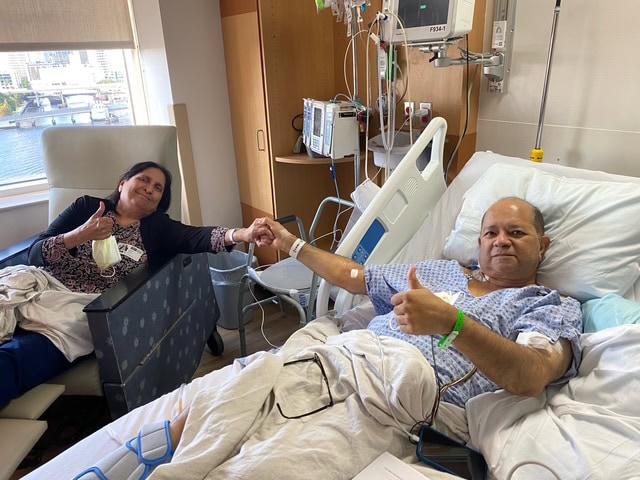
February 20 was National Caregivers Day.
I almost missed it.
Two years and four months ago, I received a kidney transplant from a deceased donor. Before that, I spent two years on dialysis – three times a week, three to four hours each session. Life became about treatments, lab numbers and waiting. Waiting for a phone call. Waiting to feel better. Waiting to feel like myself again.
People call a transplant a miracle. I won’t argue with that.
But I didn’t get there alone.
At the dialysis center, I was surrounded by nurses who showed up every single time. They knew my name, they knew my story, and they treated me like my life was worth saving. On the day I got the call from Tampa General – the morning I walked into the center to tell them I had to leave – the nurse in charge hugged me and said, “Go, Go, Go, Mr. Shenai.” That moment still stays with me. Those nurses were caregivers, too. And they mattered more than they probably know.
But there was another caregiver. Closer to home.
My wife has been my anchor for 53 years. During those two years on dialysis, she became something more. She kept track of my medications when I couldn’t think straight. She came to appointments and asked the questions I forgot to ask. She managed the routines that kept me stable – the diet, the schedules, the small daily things that quietly add up when you are sick and tired.
She did all of this without being asked. Without complaining. Without asking for anything in return.
There were days I could see the worry on her face. She never said much about it. I think she didn’t want to add to what I was already carrying. So, she carried it herself.
That’s what caregiving really is. It doesn’t always look heroic from the outside. It’s just showing up, day after day, doing what needs to be done – even when you are scared, even when no one is watching.
Through my advocacy work, I have met many patients who share a version of this story. Almost every one of them has someone standing behind them – a spouse, a parent, a sibling, a friend – quietly doing what my wife did. Making sure the patient eats right, gets to appointments, takes their medication, and doesn’t completely fall apart.
We talk a lot about transplant as a medical success. The surgery, the doctors, the moment the phone rings. All of that deserves recognition. But what about the person who helped the patient get to that point? What about the person who made sure the patient was still standing when that call finally came?
Caregivers don’t just support patients. In many ways, they make survival possible.
And yet their work is largely invisible. They rarely get asked how they are doing. They rarely get support at work for the time they give up. They rarely get a moment to say, honestly, that they are exhausted.
If we want patients to do better, we have to pay attention to the people taking care of them. That means asking caregivers how they are holding up, not just the patient. It means workplaces offering real flexibility. It means communities where it is okay to ask for help.
It means treating caregivers like they matter. Because they do.
Two years and four months after my transplant, I carry a lot of gratitude. For my donor, who gave me something I can never repay. For my medical team. For those nurses at the dialysis center who cheered me on every step of the way. And for my wife, who stood beside me through all of it.
She didn’t sign up for any of it. But she showed up for all of it.
Kidney disease is a medical diagnosis. But getting through it is something you do with the people around you.
On National Caregivers Day, I just want to say this clearly: Behind a lot of miracles, there is a quiet person doing hard work that nobody sees.
My miracle had more than one.