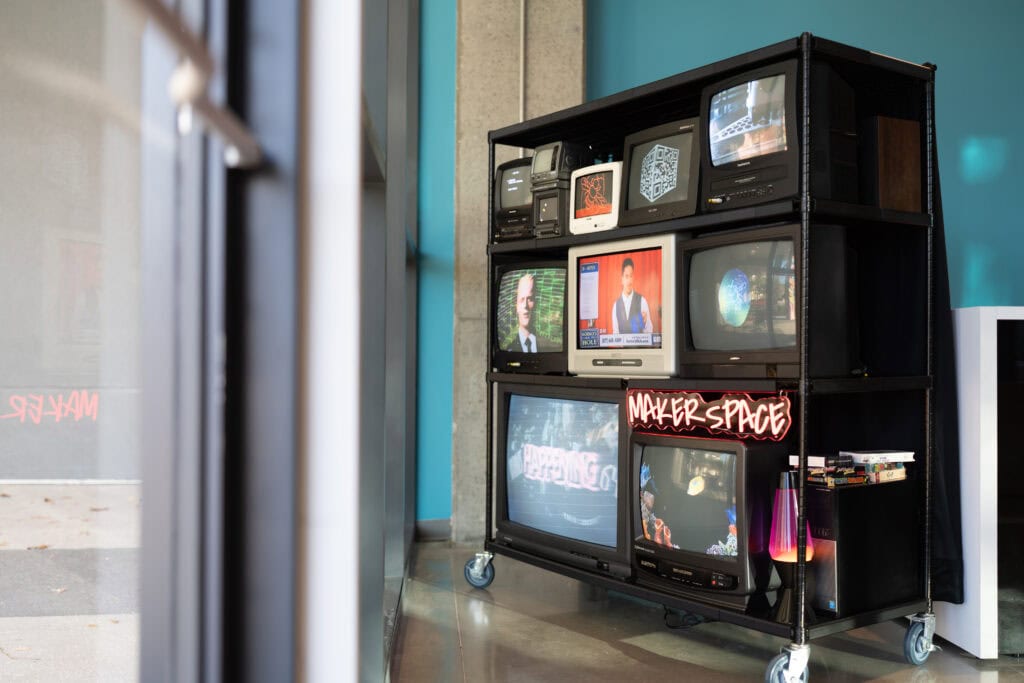
If you walk by HiveLabs’ door next to Foxtail Coffee right now, one of the first things you will notice is a glowing wall of old televisions. Some are huge, some are tiny travel radios, and few have the classic VHS player combo. When they are on, they light up the whole corner of the office entrance like a time capsule from the 1990s. Around HiveLabs, we have started calling it “the CRT pile.”
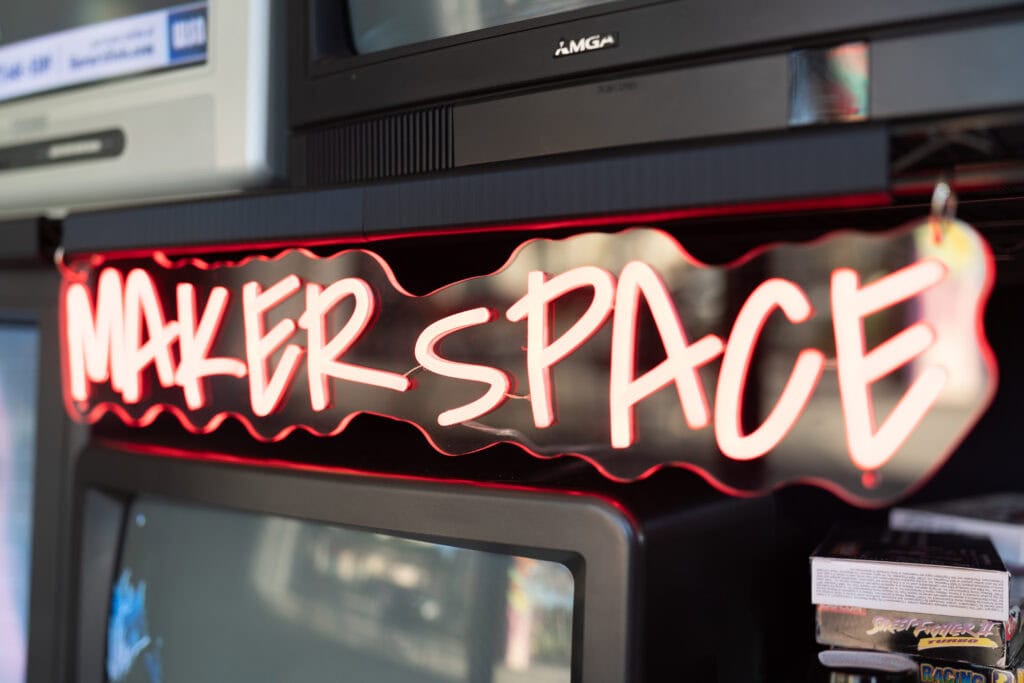
It looks a little chaotic at first. Eleven old cathode ray tube televisions stacked together on black wire shelving, each playing looping video from old VHS tapes, our YouTube videos, or some old QVC shows. There is a lava lamp glowing next to them and a fake neon sign that says “Makerspace.” Behind everything, black velvet curtains help the glow from the screens stand out. If you stand in front of it long enough, it feels a bit like stepping into an old video game store display from decades ago. But the part I like most about the CRT pile is not how it looks. It is how it started.
Every single one of these TVs was headed for the trash. Some were found sitting on the side of the road. A couple came from old office warehouses where they had been collecting dust in storage rooms for years. One of them was rescued from a barn, where it had clearly been sitting untouched for more than a decade. When I found it, the entire thing was covered in dust and cobwebs. As well as a few dozen spiders who made it their home, but I try to repress that part of that story. Honestly, I expected that one to be dead. But after cleaning it off and plugging it in, it turned on almost immediately. Volume left on full blast, and my husband heard me scream from our garage as the static yelled at me. But the screen looked great! The only thing that didn’t work was the built-in VHS player. For a television that had probably spent 10 years in a barn, that felt like a miracle.
That is something people forget about these old machines. They were built to last. Of course, before we could safely work on them, we had to deal with something a lot less nostalgic – the voltage inside the tubes. CRT televisions can hold a serious electrical charge even after they have been unplugged. Touch the wrong place, and it can stop your heart. Thankfully, one of the makers at HiveLabs had experience discharging CRTs before. Together, we built our own discharging tool using a long flathead screwdriver attached to a grounding wire. I jokingly named it “the boomstick” because, when you are working around something that can hold enough voltage to kill, a little humor helps break the tension.
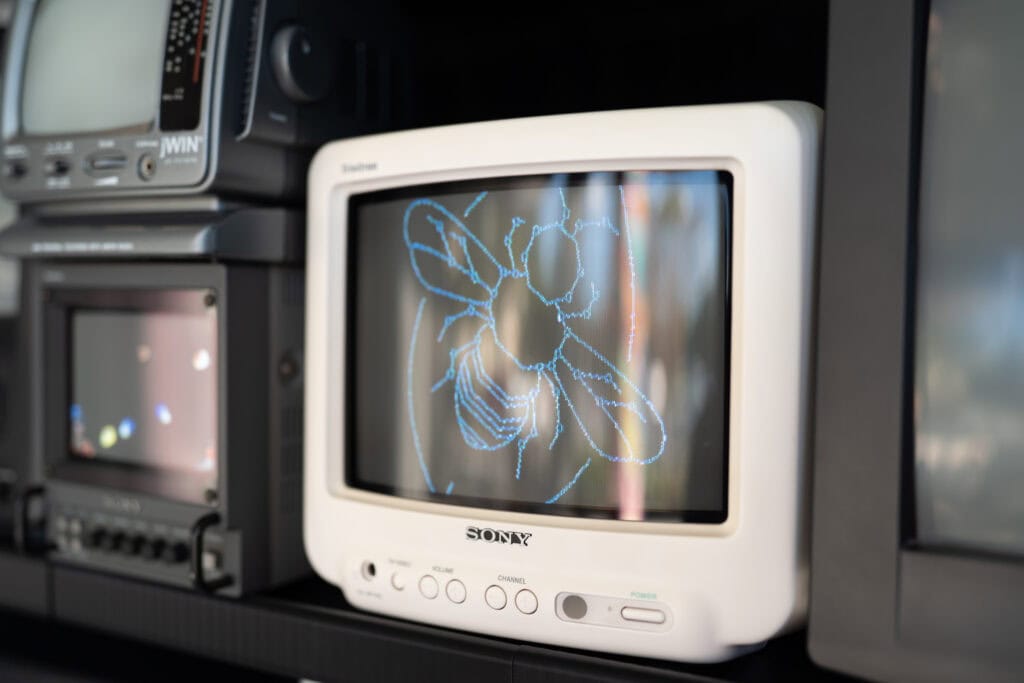
One by one, we carefully discharged each TV before opening them up for cleaning and restoration. Many of the plastic housings had years of UV damage. Sunlight slowly breaks down the plastic on older electronics, turning them dull and faded. Instead of leaving them that way, we used the same automotive restoration kits that people use to restore faded plastic car bumpers. With some patience and a lot of polishing, many of these old TVs ended up looking surprisingly close to new again. Once they were cleaned and restored, the next challenge was figuring out how to display them. I wanted them stacked together in a way that felt intentional but still a little wild, like you had stumbled across a trash pile in a movie prop warehouse. The solution ended up being a black wire shelving with wheels so it could move without crushing anyone.
To help hide the edges of the shelves, I 3D printed small brackets that sit along the front of the rack. Combined with velvet curtains behind everything, the shelves almost disappear. The real magic happens once the TVs turn on. Using a small $25 e waste computer I got on eBay, I set up a system that lets us address every screen individually. So, I could play the VHS tapes or play something from the computer.
The CRT pile ended up becoming more than just a fun display. It is a reminder that a lot of technology we throw away still has life left in it. With a little care, creativity and help from a community of makers, things that look like junk can become something meaningful again. At HiveLabs, we talk a lot about sustainability, but sometimes sustainability looks less like recycling bins and more like curiosity. Instead of asking, “Where do we throw this?” we start asking, “What else could this become?” In this case, it became a glowing stack of televisions rescued from the edge of a landfill. And honestly, it might be the coolest pile of trash I have ever seen.




Leave a Reply